Artificial intelligence is not only transforming the day-to-day operations of businesses, but is also placing new demands on IT infrastructure. This is because the more powerful AI applications become, the more computing power, electricity and cooling they require.
However, many data centres are not yet adequately prepared for this growing demand. In this article, you will learn how Eaton’s solutions help businesses overcome the challenges posed by AI.
Whether it’s chatbots, automated data analysis or industrial AI applications: behind many of these technologies lie data centres where specialised processors handle large volumes of data.
The key difference compared to many traditional IT applications lies in the nature and intensity of the calculations. Training large AI models, in particular, requires enormous computing power. However, subsequent use – known as inference – also results in a continuous demand for energy.
To ensure AI systems operate as quickly as possible, high-performance graphics processing units (GPUs) and other specialised accelerators are frequently used. These enable numerous parallel calculations, but under heavy load they also require a correspondingly high amount of electrical power.
It is not possible to give a general figure for how much this affects the energy consumption of individual AI queries. Key factors include, for example, the model size, the hardware used, the length of the query and the system’s utilisation.
A look at global electricity consumption by data centres highlights the scale of the issue.
According to the International Energy Agency (IEA), data centres worldwide consumed around 415 terawatt-hours of electricity in 2024. This represented approximately 1.5 per cent of global electricity consumption. In its baseline scenario, the IEA forecasts an increase to around 945 terawatt-hours by 2030. This means that electricity demand could more than double within six years.
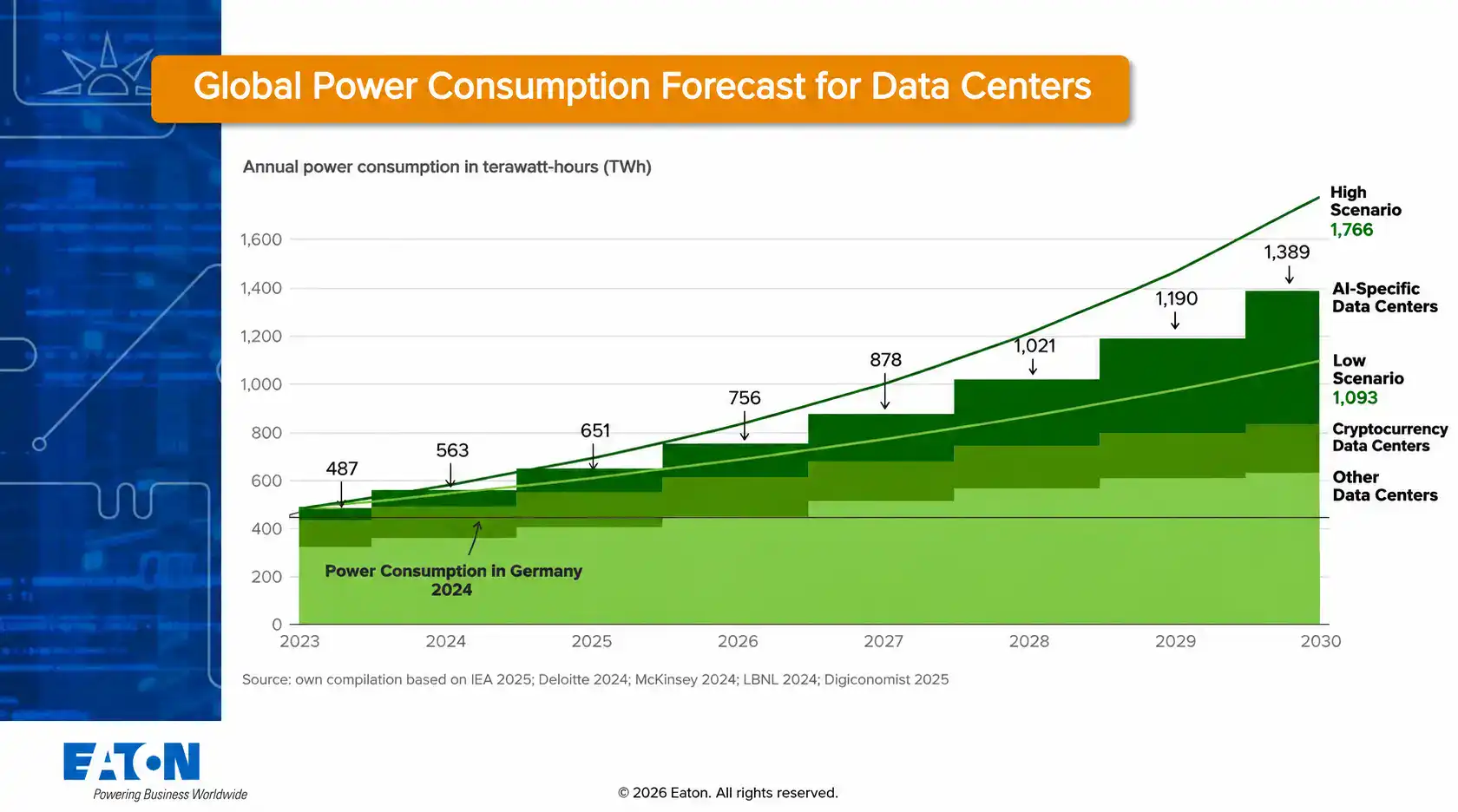
Artificial intelligence is regarded as one of the key drivers of growth in this context. However, not all of the electricity consumption of data centres is attributable to AI. Cloud services, data storage and other digital applications also contribute to this trend.
Furthermore, the forecast is not set in stone: improvements in hardware and software, the pace of AI expansion and the availability of electrical infrastructure all influence the actual trend (International Energy Agency – Energy and AI, 2025).
The impact of AI is particularly evident within server racks.
Traditional enterprise servers and GPU-based AI systems differ significantly in terms of their power consumption. Whilst conventional racks have comparatively low power densities depending on their configuration, modern AI clusters can require many times that amount.
Eaton illustrates this trend using new GPU architectures. Power ranges for future rack systems are being considered, from several hundred kilowatts up to the megawatt range.
An existing server cabinet cannot necessarily be converted into an AI rack simply by replacing its servers. As power density increases, several factors must be considered simultaneously: the available electrical power, power distribution, waste heat, available space and mechanical load-bearing capacity.
A simple example illustrates the significance of power consumption:
A rack that continuously draws 40 kW of electrical power requires, in theoretical terms, 350,400 kWh of electricity per year for its IT components alone.
This is an illustrative calculation based on constant full load. Additional power consumption for cooling and other infrastructure components has not yet been taken into account.
For this reason alone, it is not enough simply to procure more powerful servers. The entire infrastructure must be tailored to current and future loads.
The higher a data centre’s power consumption, the more important a reliable power supply becomes.
Power cuts, voltage fluctuations or other grid disturbances can disrupt the operation of AI applications. In the case of computationally intensive processes, an unplanned interruption can not only halt operations but also result in time and cost losses.
Uninterruptible power supplies (UPS) therefore play a key role. They provide temporary power in the event of an interruption to the regular power supply and help to protect connected systems from certain grid disturbances.
Scalability is crucial, particularly when planning new AI infrastructures. Modular UPS solutions can help to adapt the power supply step by step to meet increasing demands. In our shop, you will find a wide selection of Eaton UPS systems for various applications – ranging from Eaton PC and workstation UPSs, through to Eaton network and server UPSs, right up to Eaton data centre and building UPSs and Eaton marine UPSs.
Selection of suitable Eaton UPS series:
However, selecting a suitable system does not depend solely on the power output in kilowatts. Equally important are redundancy concepts, runtime, expandability, efficiency and maintenance requirements.
The Eaton Heavy-Duty Smart Racks have been specially developed to meet the demanding requirements of modern AI servers. They are available in heights of 42, 45 and 48 HE, as well as in various depths up to 1,372 mm. With a static load capacity of up to 2,268 kg, they offer sufficient stability for heavy hardware.
Furthermore, the racks allow for up to 80 per cent airflow and provide ample space for cabling, multiple PDUs and modern liquid cooling systems. The white finish also makes it easier to work inside the server cabinet.
Power distribution in the rack: the underestimated challenge
A high-performance UPS alone is not enough. The electrical power must also be delivered to the individual servers in a safe and controlled manner.
This is where Power Distribution Units (PDUs) come into play. They handle power distribution within the rack and, depending on the model, offer additional monitoring and control functions. An example from Eaton:
Eaton High Power AI PDU:
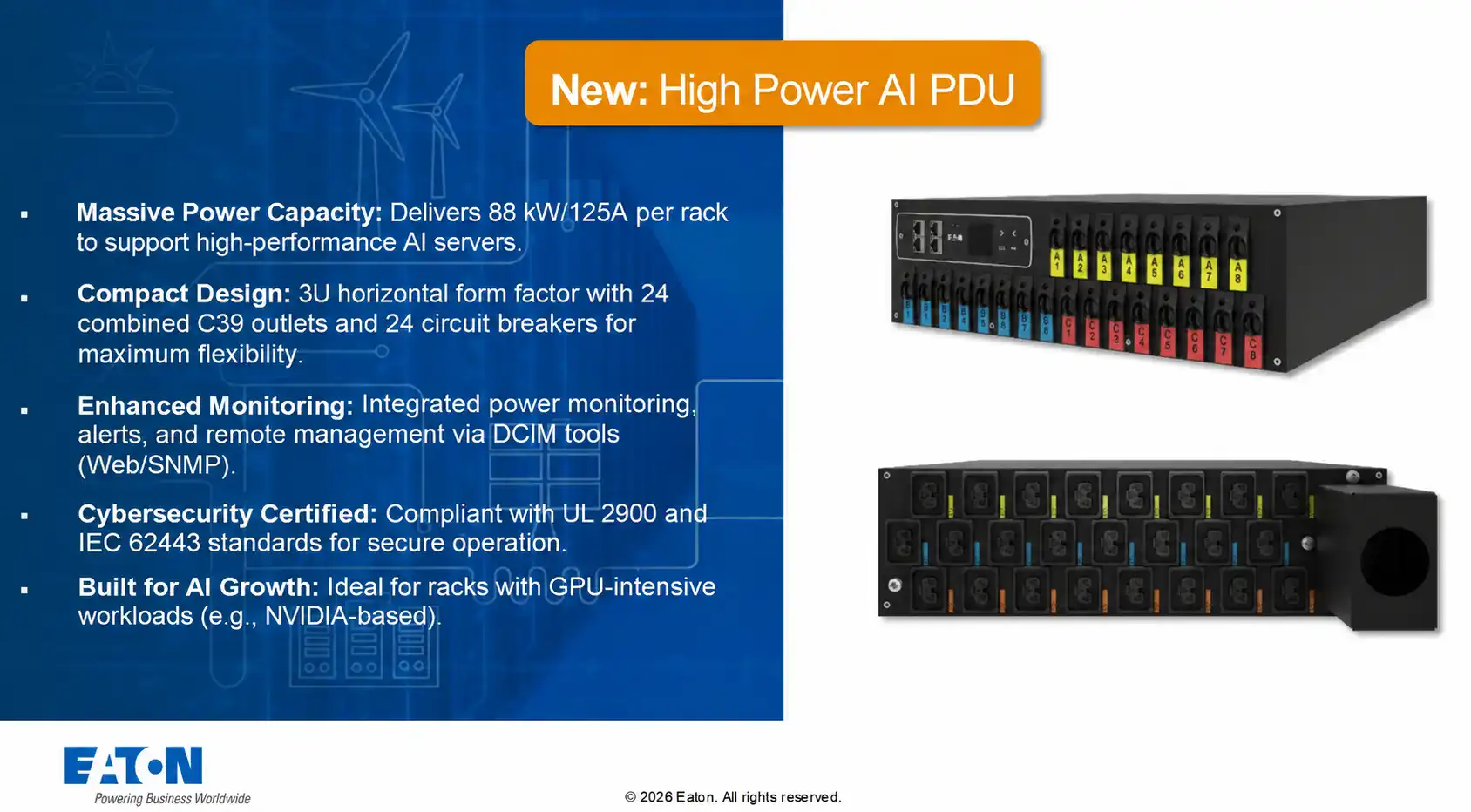
Important: The total power rating of a rack alone does not indicate whether individual circuits are correctly sized or whether the available connections are suitable for the servers in use.
When planning AI infrastructure, the focus is often on power supply and cooling. However, another aspect is easily overlooked: the weight of the hardware.
Due to their extensive computing units, heat sinks and power supplies, GPU-based servers can be considerably heavier than traditional servers.
Eaton cites typical figures of around 18 to 45 kilograms per unit of height for AI servers (standard servers: approx. 9–18 kg per 1U). This range is for illustrative purposes; the actual weight depends heavily on the specific system. In addition, some AI servers require a greater installation depth.
When selecting a server rack, businesses should consider not only the height units but also the load capacity, installation depth, floor load and sufficient space for cabling and cooling.
For particularly demanding applications, Eaton offers special heavy-duty SmartRack solutions. These racks have a static load-bearing capacity of up to 2,268 kg and are available in extra-deep configurations.
Such features are particularly relevant where numerous high-performance GPU systems need to be housed in a confined space. However, a rack’s load-bearing capacity does not replace the need to check the data centre floor. The transport route, the installation area and, where applicable, any raised floors must also be suitable for the total weight.
Virtually all the electrical energy consumed by IT hardware is dissipated as heat. As the power consumption of servers increases, so too does the challenge of reliably dissipating this heat.
In traditional data centres, cooling is often achieved using air. Cold air is fed to the servers, absorbs heat and is then recooled via suitable cooling systems. However, at very high power densities, this method can reach its technical and economic limits.
In what is known as direct-to-chip cooling, a cooling medium is channelled via suitable cooling plates in the immediate vicinity of the heat-generating components. This allows the heat to be dissipated in a targeted manner. The method is particularly suitable for processors and other components subject to high thermal loads.
However, liquid cooling does not automatically mean that air cooling is no longer required. Other server components may still require air cooling.
In immersion cooling, specially selected IT components are immersed in an electrically non-conductive cooling fluid. This absorbs the heat generated and dissipates it via a suitable cooling system.
This technology may be of interest where power densities are particularly high, but it requires hardware, fluids and maintenance processes tailored to this purpose.
For many data centres, the combination of different cooling methods is likely to be particularly relevant. Whilst particularly heat-intensive components are cooled directly with liquid, air-based systems continue to handle other thermal tasks.
Which solution makes economic sense depends, amongst other things, on the rack power, the existing building services and the servers in use.
The more complex AI data centres become, the more important it is to keep track of energy consumption, utilisation and potential issues. This is where Data Centre Infrastructure Management (DCIM) solutions come into play.
They help to consolidate key infrastructure information in a centralised manner and make it available for day-to-day operations and capacity planning.

With the Brightlayer platform, Eaton offers a range of software solutions for monitoring and managing electrical and technical infrastructure.
These include, for example, functions for energy and power monitoring, the monitoring of UPS and PDU systems, and the management of data centre capacity.
The main benefits of such solutions lie in providing a better overview of the condition and utilisation of the infrastructure. This enables operators, for example, to identify whether individual circuits are under heavy load, to track trends in energy distribution, or to determine where additional capacity is required.
Perhaps the most significant change brought about by the AI boom does not concern a single product, but rather the overall design of data centres.
Traditionally, power supply, cooling, server racks and IT hardware are often regarded as separate areas. In the case of high-density AI systems, however, these components are particularly closely interlinked.
A more powerful GPU can result in higher power consumption. This increases the thermal load, alters cooling requirements and may necessitate new power distribution or rack designs. Eaton addresses this interdependence with its ‘From Grid to Chip’ approach, which involves considering the entire energy infrastructure.
The idea behind this is that an AI infrastructure will only function reliably in the long term if its individual components are coordinated with one another.
Artificial intelligence opens up new opportunities for businesses – but at the same time presents their technical infrastructure with new challenges.
Increasing demands on power supply and cooling are changing the way data centres are planned. It is crucial to utilise the available capacity efficiently, reliably and flexibly.
Suppliers such as Eaton demonstrate how these areas can be integrated into a holistic infrastructure concept. Companies are therefore advised to assess their existing capacities at an early stage.